I don’t like using the word “bitch” because it has a derogatory meaning in common language, but there is actually a difference between the words dam/bitch.
Continue reading “Dam or Bitch?”
I don’t like using the word “bitch” because it has a derogatory meaning in common language, but there is actually a difference between the words dam/bitch.
Continue reading “Dam or Bitch?”
We’ve been careful and fortunate that we’ve gone 3 years without a hot spot; that lucky streak ended this week. This post shares what I’ve learned during this process.
Continue reading “Hot Spots!”
I’m excited to share some of Dixie Rose’s latest nose work lessons at school. I’ve decided to create a training diary and capture it on YouTube. She practices at home, but she especially loves attending school and learning from our teacher Julie Gaunt.
This search was a first for us!! She did 2 paired hides but then a BLANK ROOM.
I’ll be uploading more videos on a regular basis. You can subscribe to the video training diary on Dixie Rose’s new YouTube Channel.
I’m excited to share some of Dixie Rose’s latest nose work lessons at school. I’ve decided to create a training diary and capture it on YouTube. She practices at home, but she especially loves attending school and learning from our teacher Julie Gaunt.
Each week she generally does 3-4 searches with 1-2 hides each search.
Subscribe to our Video Diary on Dixie Rose’s new YouTube Channel.
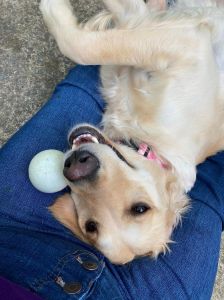
Golden Retrievers are classified as a sporting breed. They are one of the most popular dog breeds worldwide, known for their friendly disposition, intelligence, and versatility. They are not only excellent family pets but also excel in various roles such as service dogs, therapy dogs, and hunting companions. To keep a Golden Retriever healthy and happy, regular exercise is crucial. This blog post explores the exercise needs of Golden Retrievers and offers tips on how to meet those needs.
Golden Retrievers are active, energetic dogs that require ample exercise to maintain their physical and mental health. Regular exercise helps prevent obesity, a common issue in this breed, and reduces the risk of related health problems like joint issues and heart disease. Additionally, exercise is essential for their mental well-being, as it helps to prevent boredom and the development of destructive behaviors.
A healthy adult Golden Retriever typically needs at least one to two hours of exercise each day. This can be broken down into multiple sessions to suit your schedule and your dog’s energy levels. Puppies and young dogs may need more frequent, shorter bursts of activity to accommodate their developing bodies and boundless energy.
Our “goal” for Dixie Rose each day is a casual morning walk lasting about 30 minutes and a vigorous evening 45-60 minutes of fetch at our local soccer field with her obsession: the lacrosse ball. When it’s raining or especially uncomfortable heat/cold, we might skip the field and have a second walk indoors at Lowes or Home Depot. We aren’t perfect, but we work hard to reach this goal.
Golden Retrievers thrive on regular exercise, which helps keep them physically fit and mentally sharp. By incorporating various activities into your dog’s routine, you can ensure they stay healthy, happy, and well-behaved. Whether it’s a daily walk, a game of fetch, or a swim in the lake, your Golden Retriever will appreciate the effort you put into meeting their exercise needs.
I learned today that vets have some of the highest rates of suicide in the healthcare profession. Our vets are literally dying from compassion and empathy for our pets.
Continue reading “Suicide in Veterinary Medicine”
Golden retrievers are known for their intelligence and trainability, which makes teaching them a variety of words possible. Obviously, we expect our dogs to learn the words we use every day (walk, sit, ball, etc.), but when a dog knows the language, it means they interact with our language! This sometimes catches us unprepared- like when I say that I’m going for a “walk with my neighbor” but of course Dixie Rose only hears “walk” and thinks I’m taking her with me. I love that she knows so many words, and she’s not yet 3, but she is well on her way to a rich vocabulary. I think the key to good training (behavior) is sharing language. The desire to communicate and convey meaning allows a dog to understand what is expected of him or her. This eliminates the frustration of disobedience. Now I spell w-a-l-k, when I’m walking with my neighbor, but she’s on to me.
Tips to Teach Your Dog Key Words

Tracing a dog’s lineage is fun as long as your dog’s ancestors are registered. Unregistered dogs pose challenges, mainly because they create a break in the chain. Imagine trying to trace your family tree without knowing your grandparents. It’s so valuable when owners register their dogs.
The first place to start is the AKC website. If your dog or your dog’s parents are registered, they will have the first 5-6 generations online for you to view. You can take that info over to K9Data.com database and go back as far as possible, until you hit a dead end.
With Dixie Rose, I hit gold and traced her lineage back to the inaugural golden retriever, Cowslip, born in 1864 to Belle and Nous. Linking to that litter, in my opinion, obligates us to keep reistering our offspring! It’s a privilege to possess such a thorough lineage, and I earnestly hope that future owners of her descendants will uphold the tradition of registration for generations to come.
AKC Pedigree Start Here: first 6 generations
K9Data.com Build Here: back to the origin
Original Golden Retriever Nous’s Pedigree

Our golden retriever is a beautiful dog. She is technically AKC registered as a “light golden” (one of the only 3 recognized colors of golden retrievers) but in layman’s terms, I sometimes describe my Dixie Rose as a “strawberry blond.” For Dixie Rose, it’s all about the sunlight. In bright sun she is more red, but indoors and at dusk, she’s more blond. She has patches of very light fur and beautiful waves.
Continue reading “Golden Retriever Coloring”
The American Kennel Club (AKC) describes the golden retriever as an exuberant Scottish gundog of great beauty, a serious worker, a superb guide for the blind, and a competent search-and-rescue dog. Of course, it’s also one of the most popular dogs in America – but does it bark a lot?
Continue reading “Do Golden Retrievers Bark a Lot?”
Socialization is the process of introducing your puppy to the world in a way that will help him be confident and unafraid of people, places and things that he will encounter throughout his life. The most critical socialization window occurs before the age of 12 weeks, and that window is considered to be closing by 5 months.
At the bottom of this post you’ll find a list of 100 exposures to accomplish in 100 days! That should be your goal!
At 8 weeks when most people get their pup, the pup has been “group socialized” within the litter and in the home. It is VERY important to do “solo socialization” between 8-12 weeks. At 12 weeks, the socialization window closes!
This is when your puppy learns what things are happy, friendly, normal, and fun.
Everything your puppy hasn’t been exposed to will cause him/her to feel threatened. That means every noise, texture, sight, smell, person, animal, event, and challenge they haven’t seen by week 12 is going to give you trouble down the road.
The way you set the puppy up for success in life, and create a dog who approaches every challenge with bright optimism, assumes every person is wonderful, and communicates well with every dog, is to expose him or her SOLO to everything the dog can reasonably expect to encounter. And it MUST be done before 12 weeks. Doing this correctly as a new puppy owner is practically a full-time job.
Every single day ask yourself “Who can I take this dog to see; where can we go; what smells can we smell; what textures can I put under her feet?”
NOTE OF CAUTION: Your puppy isn’t fully vaccinated yet and you need to beware
of other dogs! Keep your puppies out of pet stores, off the floor of your vet’s office, and ABSOLUTELY not at the dog park. After 14 weeks when your pup is fully vaccinated, those places are safe with supervision. Your pup must be socialized during this critical time, but without being exposed to health risks.
After week 12, push the dog socialization VERY hard once the 14-week shots
have been given.
Printable Puppy Socialization Checklist from the Louisiana SPCA
Alarm clock
Baby crying
Barking dogs
Car honking
Cheering
Doorbell
Female voices
Fire engine/police car
Fireworks
Grooming clippers
Gunshot
Hair dryer
Hammering
Knocking on door
Kids Playing
Male voices
Microwave
Motorcycle
Planes/helicopters
Popcorn popping
Pots and pans clanking
Radio (various stations)
Smoke alarm
Thunder
Traffic/road sounds
TV (various programming)
Vacuum cleaner
Whistles (sporting or other)
Yard tools (mower, leaf blower, etc.)
Artificial turf
Bathtub
Blankets
Carpeted floors
Elevators
Grass
Metal objects
Mirrors
Mud
Plastic objects
Rocks
Rubber objects
Rugs
Sand
Sidewalk
Tiled floors
Wood floors
A wheelchair
Asian
Bald people
Black
Carrying bags/boxes
Children (children who have been trained properly on dog interaction)
Dancing
Elderly (as long as they aren’t immunocompromised)
Heavy people
Hispanic
Holding umbrellas
In uniform
Infants
Kids in strollers
Laying down
Men
On bicycles, scooters, and skateboards
People in sunglasses/glasses
People with facial hair
Running
Short
Shuffling feet/limping
Sweeping/mopping
Taking their toy or food away (invading space)
Tall
Teens
Thin people
Throwing or bouncing balls
Using a walker
Walking with canes
Wearing baseball hats
White
Women
Birds
Cats
Other (depending on likelihood of interaction)
Other dogs
Being dried off with towel
Being picked up
Being restrained by collar
Brushing fur
Brushing teeth
Clothes (winter jacket, boots)
Ears
Harness
Mouth
Muzzle
Nail clipping
Near eyes
Paws
Rain
Tummy
Tushy
Water (bath)
I enjoy bringing Dixie Rose to dog-friendly stores and restaurants, but pups aren’t welcome everywhere. I’m always a little skeptical when I see someone with their dog sporting a $17 Amazon special harness and boldly marching past the store greeter with a “dare you to stop me” confidence.
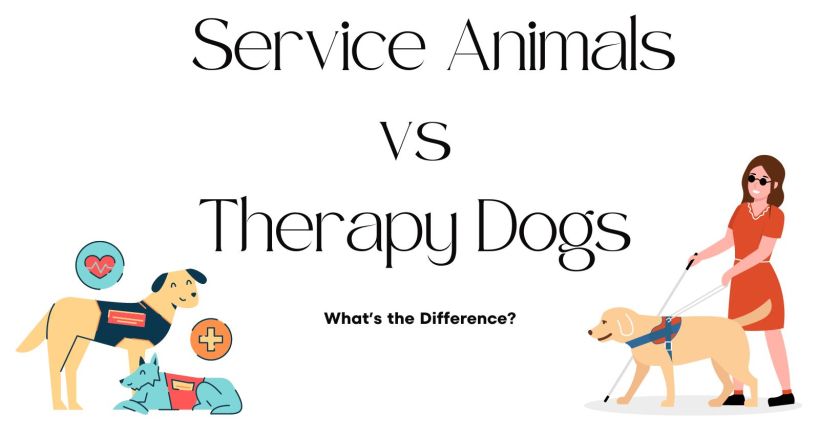
The truth is that dogs are service animals under titles II and III of the ADA. The Americans with Disabilities Act is not an “option” it’s a Federal law. The law defines a service animal (dog) as “dogs that are individually trained to do work or perform tasks for people with disabilities.”
Under the ADA, State and local governments, businesses, and nonprofit organizations that serve the public generally must allow service animals to accompany people with disabilities in all areas of the facility where the public is allowed to go.
Since the public isn’t allowed everywhere, there are places a service dog can’t go, at least without permission. A service dog must be on a leash and under the handler’s control.
If you’re a business owner, you have permission to ask 2 questions of the patron with their service animal.
You may not…
You may, however, ask the owner and animal to leave if they are not housebroken or if the dog is out of control.
For full ADA Requirements, visit the U.S. Department of Justice Civil Rights Division Service Animals page
Does the ADA require that service animals be certified as service animals?
No. Covered entities may not require documentation, such as proof that the animal has been certified, trained, or licensed as a service animal, as a condition for entry.
Some individuals and organizations sell service animal certification or registration documents online. These documents do not convey any rights under the ADA and the Department of Justice does not recognize them as proof that the dog is a service animal.
(ADA Government FAQ for Service Dogs)
Are emotional support, therapy, comfort, or companion animals considered service animals under the ADA?
No. These terms are used to describe animals that provide comfort just by being with a person. Because they have not been trained to perform a specific job or task, they do not qualify as service animals under the ADA. However, some State or local governments have laws that allow people to take emotional support animals into public places. You may check with your State and local government agencies to learn about these laws.
If someone’s dog calms them when having an anxiety attack, does this qualify it as a service animal?
It depends. The ADA makes a distinction between psychiatric service animals and emotional support animals. If the dog has been trained to sense that an anxiety attack is about to happen and take a specific action to help avoid the attack or lessen its impact, that would qualify as a service animal. However, if the dog’s mere presence provides comfort, that would not be considered a service animal under the ADA.
Does the ADA require service animals to be professionally trained?
No. People with disabilities have the right to train the dog themselves and are not required to use a professional service dog training program.
Are service-animals-in-training considered service animals under the ADA?
No. Under the ADA, the dog must already be trained before it can be taken into public places. However, some State or local laws cover animals that are still in training.
Do service animals have to wear a vest or patch or special harness identifying them as service animals?
No. The ADA does not require service animals to wear a vest, ID tag, or specific harness.
We are thrilled to announce that we are joining the AKC Breeding with H.E.A.R.T. program. We aren’t eligible until our litter has arrived, so still several months away, but making the decision to participate was an important one! This is an opportunity for us to demonstrate good breeder ethics, and our commitment to placing puppies in good homes with good families.
We certify that our breeding stock is health tested in accordance with the recommendations of the Golden Retriever Club of America.
We promise to participate in annual AKC-approved continuing breeder education program.
We agree to comply with the AKC Care and Conditions Policy, including inspections by the AKC, and disclose the results of our AKC health testing and continuing education documentation.
We accept responsibility for the health and well-being of the puppies we produce and for complying with all laws regarding the ownership and maintenance of dogs.
We agree to uphold the AKC’s tradition of breeding purebred dogs that are happy and healthy.
You know Dixie Rose is trained to detect birch, clove, and anise essential oils. Her search is for sport, but it’s the same principle used to train scent detection for work. Our scent teacher often reminds us that the dog already detects the odor; it’s the handler who has to be trained to recognize the dog’s detection! With Dixie Rose in her second year of training for sport, I know the tremendous amount of work that goes into building this relationship with your dog. I really admire those who do that hard work!
Dogs can detect the odor signatures of various types of cancers. Like many diseases, cancer leaves an odor signature dogs can detect, depending on the type of cancer. Dogs are known to be able to detect these types of cancers:
Dogs are currently working as trained companions for diabetics. They are able to detect both high and low blood sugar events before they become dangerous.
Intriguingly, Diabetic Alert Dogs are trained to smell a chemical change at a precise level. The dogs detect isoprene, a common natural chemical found in human breath that rises significantly during an episode of low blood sugar. Humans can’t detect it, but researchers believe dogs are particularly sensitive to it.
Research conducted in a pilot study at the University of Helsinki found dogs are able to recognize the signature scent of coronavirus SARS-CoV-2, the virus known as COVID-19. The dogs were able to accurately distinguish urine samples of COVID-19 infected adults from samples of healthy individuals, almost as accurately as a standard polymerase chain reaction (PCR) test.
Truffles are considered a culinary delicacy. They grow underground near certain types of trees. For centuries, pigs were used to hunt these pungent fungi. Unfortunately, pigs not only can locate truffles, they also like to eat them, making them less-than-ideal truffle hunters. Dogs, on the other hand, show no inclination of wanting to eat their find.
Wine-growers all over the world depend on dogs to find potentially tainted wine by identifying 2,4,6-trichloroanisole (TCA). The TCA molecule imparts a musty odor and flavor to wine, making it unpalatable.
Bed bugs are a growing problem in many major cities. One way to combat a bed bug infestation is to used trained canines who can sniff out the little creatures with a 98 percent accurate detection rate. Many people have benefitted from dogs who are able to find bed bugs before they become a serious problem.
I recently learned that dogs were being trained to detect pinhole leaks in pipelines! I went down the internet rabbit hole and discovered this amazing company that trains dogs in this field. I wonder if this would make a nice winter activity this year?

I follow a popular Golden Retriever blog called The Canine Chasm. Maegan, the writer, is also the founder of the Natural State Golden Retriever Club and owner of champion Golden Retrievers. I encourage you to check out her blog, but today, I want to share a checklist from her 2021 post How to Recognize Ethical Breeders. Maegan’s post is “famous” in Golden Retriever circles, and is frequently cited when helping parents avoid puppy mills.
Before I share Maegan’s checklist, I want to discuss breeding ethics. Breeding ethics would be a topic if it weren’t for the fact that ethical breeders produce pups that command top dollar! ($3,000 – $4,500+) It is that price tag that attracts the unprincipled breeder AND the bargain hunters. As you’ll see in a moment, getting a Golden Retriever to the point of having “health clearances” will result in quality pups that ARE expensive. Let me say that again- it costs a LOT of money to bring forward a litter properly. If you see $500 AKC registered purebred golden retriever pups for sale, there isn’t a chance in heck that they’ve come from a breeder that provided an ounce of proper care to the dam/sire or the litter. What makes it hard to spot an unethical breeder is that they know buyers will be suspicious of $500 dogs, so they up the price to $2,500 and hope you won’t ask questions.
Along with the list of extensive testing, are routine healthcare costs, training, and excellent nutrition. The dog must be at least 2 years old before any ethical breeder considers a mating, so the breeder is spending thousands (sometimes tens of thousands) of dollars before they even know if their dog will make the cut to for breeding. (In terms of health, the bare minimum is to have earned a CHIC number.) Ethical breeders will disqualify any dog from their breeding program if it doesn’t pass EVERY. SINGLE. TEST. necessary to earn a CHIC number. While there aren’t costs associated with other factors like temperament or conformity, there is a lot riding on the ethical breeder’s shoulders. It’s a very nerve-wracking 2 years, and it requires a commitment to the process. It’s entirely possible to invest $10,000 into a dog only to learn they don’t pass their final exam.
A CHIC number in dog breeding refers to the Canine Health Information Center number. It’s a program established by the Orthopedic Foundation for Animals (OFA) in collaboration with various breed clubs. The CHIC program aims to promote the health and welfare of purebred dogs by encouraging breeders to perform specific health tests on their breeding stock. Once a dog has completed all required health tests and the results are submitted to the OFA, they receive a CHIC number, indicating that they have met the health testing requirements for their breed. This information helps potential puppy buyers identify breeders who prioritize health screening in their breeding programs.
Once the dog is qualified to breed, searching for a qualified male (his semen) begins. The costs of arranging the mating are also very steep. No ethical breeder will consider mating with a dog that has not followed the same rigorous health standards, so studs that have undergone the same testing (and costs) are also expensive. The expenses for procedures like sperm extraction, sperm vitality testing, shipping, progesterone testing, implantation, x-rays, ultrasounds, and more are all carried out by veterinarians, who understandably charge for these services. In all, going through this process adds thousands of dollars to the cost of a litter.
Once pregnancy is confirmed, careful and diligent screening of potential homes can begin. Ethical breeders meet the family, make sure the family can and will invest in the health and wellness of the pup, and will also make sure the personality of each pup is a good fit for their home. Ethical breeders register the litters, provide medical care, provide 24/7 round-the-clock care for no less than 8 weeks, and handle all of the paperwork to make sure your pup comes to your home with a verifiable pedigree. Some breeders do extra, like microchipping or DNA testing. This intensive diligence, attention to every detail, and enormous financial investment results in a high price for these pups.
The high price tag isn’t because the breeder is seeking a big “profit.” It’s because it costs a lot of money to bring forward a litter the right way. An ethical breeder may invest $7,000 – $9,000 into the dog before the pregnancy, and then the costs associated with the pregnancy and delivery. The ethical breeder will also invest in the physical space for the birth, the care of the pups, register the litter with AKC, and give the pups regular medical care and vaccinations before they ever get to your home. The pups are reaised safely indoors, given stimulation, age-appropriate training, brain stimulation, and an opportunity to get the very best start.
An ethical breeder sometimes earns a profit on a litter when everything goes perfectly- but when taken in balance against the tremendous amount of hours dedicated to the litter and the occasional c-section ($), you won’t get rich breeding pups unless you’re cutting corners.
An unethical breeder skips all the work, care, diligence, and investment. They keep costs and care to the bare minimum. Short of keeping the pups alive, they are far from thriving under such lean conditions. An unethical breeder may have invested less than $1,000 in their dam, and even less in bringing forward a litter. (Yes, there are unethical breeders who bring their fertile female to a dog park and let her play until they get a “free” sperm donor). In that case, with the “cost” of the litter being so low, the motive for profit is extraordinary, and that creates the climate for puppy mills and unethical breeders.
Any dog can still become a loving member of your family, no matter where it’s from, but purchasing a dog from an unethical breeder keeps them in business. The market will extinguish these breeders when the demand stops.
This is not an all-inclusive list of things that unethical breeders do incorrectly, but most unethical breeders do at least some of these.
In future posts, I’ll explore those red flags and why they are important, but in this post, let’s move on to the GOOD things an ETHICAL breeder does! These are “Green” for go!
Hobby breeders are stewards of their breed, preserving and protecting it for the future. Green flags are things that ethical breeders do that set them apart from the others.
In every case, whether you’re considering our pups or not, I hope this post helps you find the best puppy for your family from an ethical breeder.
People are quick to point out that there are no bad dogs- only bad owners, but there are breeds that are more accommodating to the owner’s wishes, quicker to learn the owner’s demands, and naturally more agreeable. Owners who are determined to work with their dog 24/7/365 will undoubtedly end up with a “good dog” of any breed, but starting with a dog breed like the golden retriever (“easier”) allows the owner to be a little less perfect while still getting a great dog. Still, raising an easy dog is a lot of work.
Continue reading “An Easy Dog is Not a Houseplant”
Dogs that are “only” family pets do not need OFA testing, but all dogs who are being considered for breeding need “all” OFA testing. Even pets may benefit from OFA testing, so if you’re curious about it, ask your vet if extra testing is recommended.
In the case of this breeding pair (Dixie Rose x Sir Reddington), both dogs have earned CHIC numbers, which indicates they have both undergone “all” testing. This is the most extensive screening available. Pursuing a CHIC number is a long and expensive process that could disqualify a healthy dog at any point. Making it through all the tests ensures, to the best of our ability, that our dogs do not knowingly pass along the congenital conditions most common in this breed.
While not 100% guaranteed that a pup’s offspring won’t develop a condition later in life, we can confidently say that both dogs passed their OFA tests with flying colors!
Recommended Tests
CHIC Program Requirements
Working with the breed’s parent club, the OFA recommends the following basic health screening tests for all breeding stock. Dogs meeting these basic health screening requirements will be issued Canine Health Information Center (CHIC) numbers. For CHIC certification, all results do not need to be normal, but they must all be in the public domain so responsible breeders can make more informed breeding decisions.
For potential puppy buyers, CHIC certification indicates that the breeder responsibly factors good health into their selection criteria.
The breed-specific list below represents the basic health screening recommendations.
| Screening | Testing options | Dixie Rose | Sir Reddington |
|---|---|---|---|
| Hip Dysplasia | One of the following: OFA Radiographic Hip Evaluation or PennHIP Evaluation (At least 4 months of age) | OFA | OFA |
| Elbow Dysplasia | OFA Radiographic Elbow Evaluation | OFA | OFA |
| ACVO Eye Exam | Annual Eye Examinations. Results registered with OFA | OFA | OFA |
| Cardiac Evaluation | One of the following: Congenital Cardiac Exam at 12 months or older, with exam by cardiologist Advanced Cardiac Exam Basic Cardiac Exam at 12 months or older, with exam by cardiologist | Advanced | Advanced |
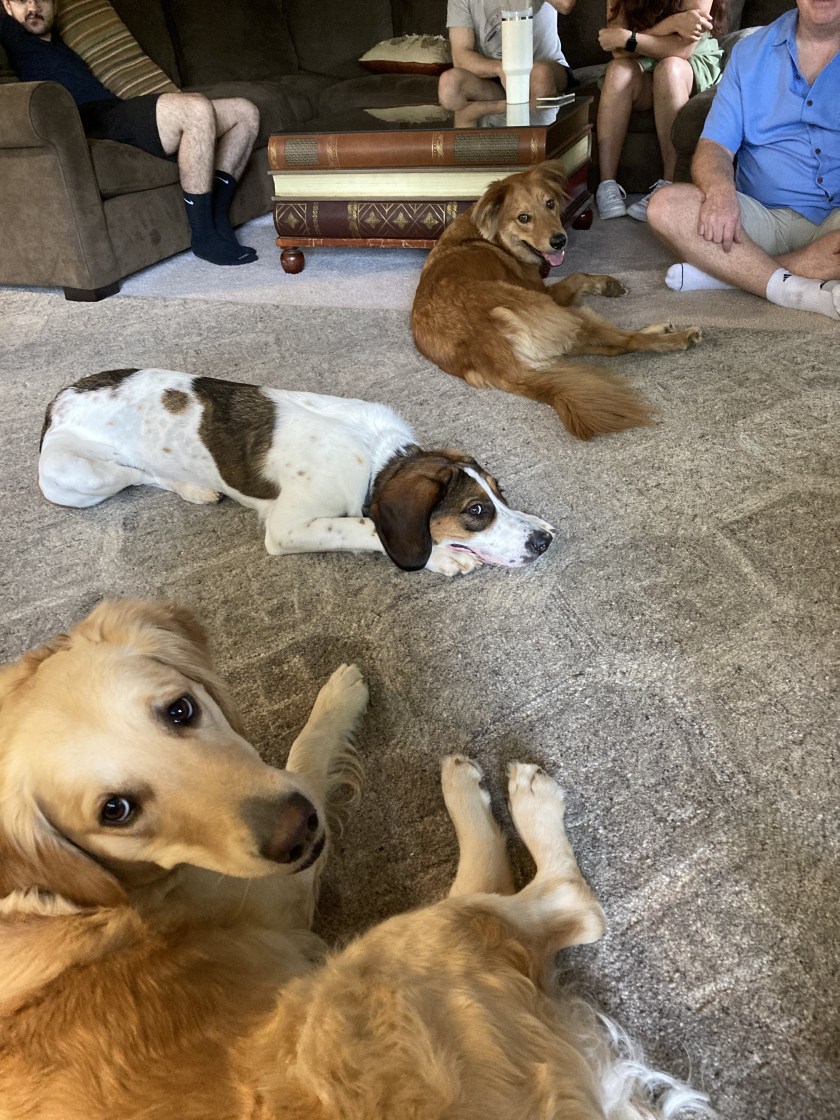
Raising a puppy indoors offers several advantages compared to raising them outdoors:
Socialization: Indoor environments typically provide more opportunities for puppies to interact with people, other pets, and various household stimuli. This exposure helps them develop better social skills and adaptability.
Safety: Indoors, puppies are protected from outdoor hazards such as extreme weather, predators, poisonous plants, and traffic. This controlled environment reduces the risk of accidents or illnesses.
Comfort: Puppies raised indoors are more likely to be comfortable and secure, benefiting from a consistent temperature, shelter, and access to amenities like beds, toys, and designated potty areas.
Training: Indoor settings facilitate easier training and supervision, as owners can closely monitor behavior, implement house training routines, and provide immediate feedback and guidance.
Bonding: Living indoors with humans fosters a stronger bond between puppies and their owners or caregivers. The close proximity allows for more frequent interactions, affection, and attention, which are essential for a healthy emotional connection.
Overall, raising a puppy indoors provides a nurturing, safe, and conducive environment for their physical, mental, and emotional development.
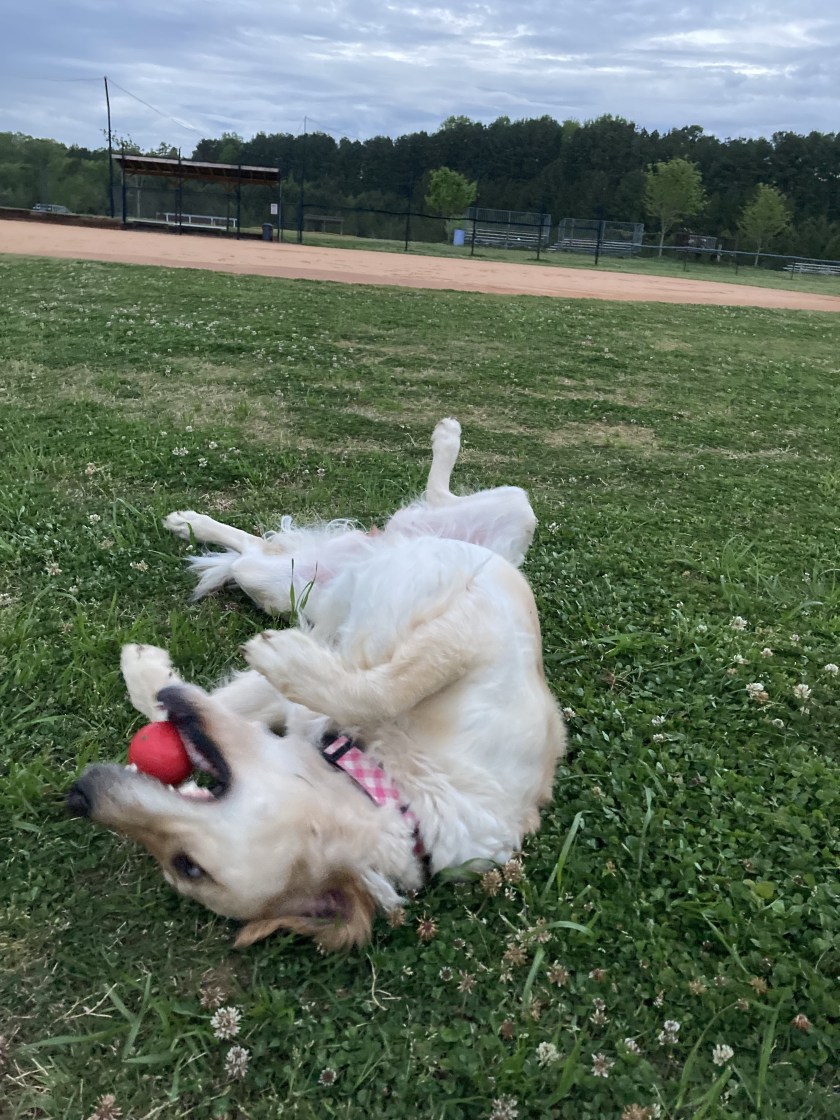
After a brief maternity leave, our K9 Nosework instructor has resumed classes and we are back at it! (We really should have practiced more over our break… maybe she won’t notice?)
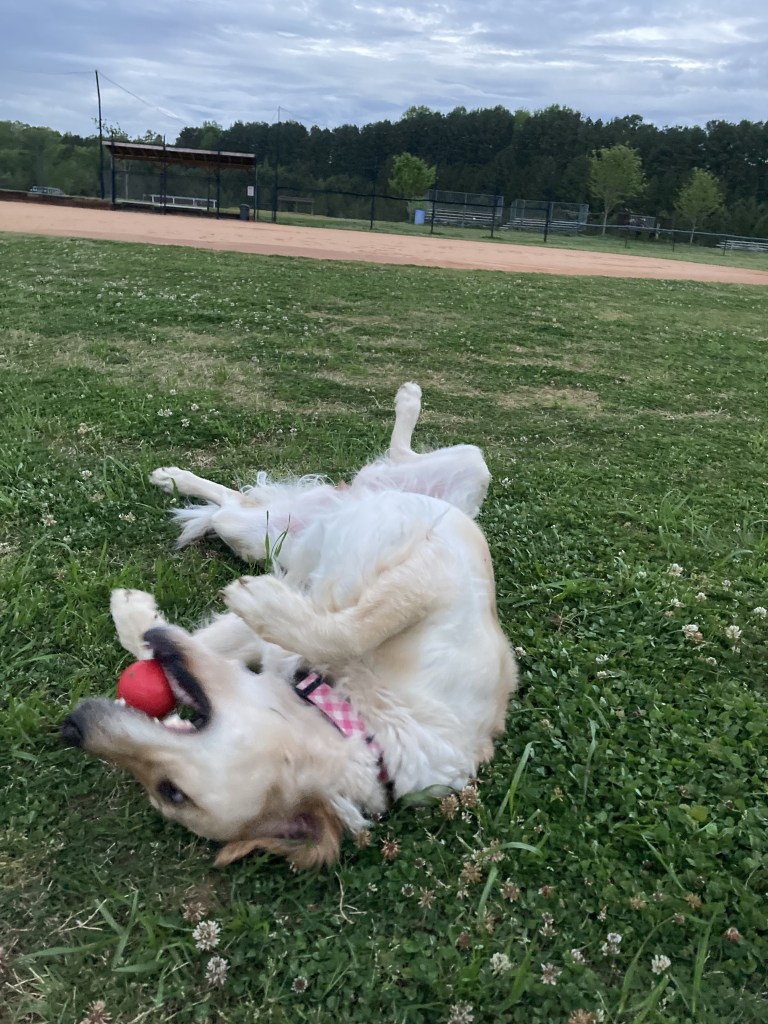
Dixie Rose’s class is called “Advanced Odor” and is taught by the famous Julie Gaunt!
Advanced Odor means Dixie Rose will locate 3 target odors
She will receive a treat when she finds each odor. We had the option of training her using her favorite toy in the world (a lacrosse ball) which would be HIGHLY motivating for her, however, she’s not well-behaved with her ball. <smile> If she enters a competition and we reward her with her ball, things might go downhill fast, so we use her less-than-favorite motivator: treats.
Here’s a little bit about our awesome instructor Julie Gaunt from her Nose Work bio.
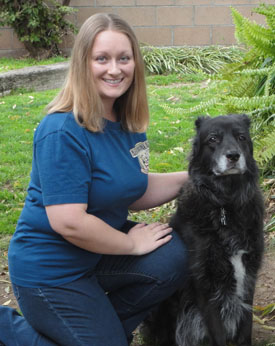
Julie brings to K9 Nose Work instruction a lifetime of K9 education and training. Growing up in a home shared with many a working police K9, Julie quickly built an understanding of the working dog and their unique requirements. Julie prides herself on developing solid working relationships with her K9 partners through mutual understanding and respect.
At the age of 9 Julie won her first competition with her young German Shepherd Dog. That young dog continued a training career that included Schutzhund, a sport that encompasses obedience, tracking and protection elements. Throughout her life, she has worked with German Shepherds, Springer Spaniels, Labrador Retrievers, Belgian Malinois, a Pitbull and a few all American mixed breeds.
Currently, Julie is a professional detection dog handler and is a certified member of the International Association of Bomb Technicians & Investigators as well as the International Explosive Detection Dog Association. Julie works in the private sector in Southern California as a detection dog trainer/handler. Julie successfully completed schools in both Narcotics and Explosive Detection and attends the California Narcotic Canine Association conference annually. Her passion for dog training goes beyond detection, as a result of this Julie continues to attend many workshops and seminars on dog training and behavior. Julie brings her passion for dogs and for learning to her time instructing K9 Nose Work classes.
Julie has been a Certified Nose Work Instructor since 2008. She has worked with the NACSW judging, certifying and volunteering in many trials in California, Colorado, Massachusetts and Alaska. She has also worked with the founders teaching K9 Nose Work Workshops. Julie enjoys every aspect of being part of the K9 Nose Work and NASCW family and is proud to be part of this great canine activity and sport.
You can learn more about NoseWork Training and the sport of scent detection HERE.
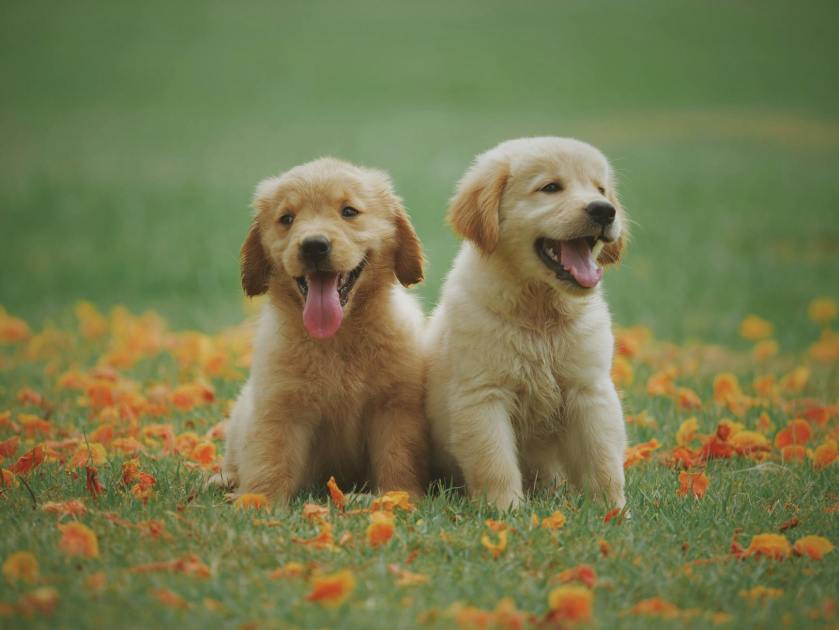
There is no question a purebred registered pup can cost several thousand dollars. With most small breeders who take the time to ensure their dog has all health and genetic clearances and plan 1-3 litters in their dog’s lifetime, it is unlikely that they will make anything other than a modest profit. The costs you must incur before a dog is qualified to breed (assuming you’re a responsible breeder) are such that the first and even possibly the second litter will not result in the small breeder breaking even financially. For ethical and responsible breeding, it takes TWO YEARS of extensive testing before a dog can even be considered for breeding. Given the time and financial investment, a small breeder usually has pure motives and a clean conscience if they have persisted through those steps.
To “make money” as a breeder, you have to either cut corners, increase your price, or increase the number of dogs you have. How can you tell if a breeder is motivated by profit over health? Breeders do this in ways that may not immediately be obvious to the general public.
Tracing a dog’s pedigree is fun, at least for a while, but unregistered dogs create deadends that require the tedious task of repeatedly starting over. To trace our full ancestry meant going back 45 generations. Mathematically, that’s over 2 trillion ancestors! Thankfully, I didn’t have to chase down every possibility because of the K9Data.com database.
When you enter your registered dog into the database, your dog’s parents (if registered) will be traceable. This system only works when owners take the time to register their dogs and pre-internet, it meant each owner kept careful breeding logs. Since owners of show dogs and competition dogs are usually registered, I had a huge head start. The first 6 generations were easy because AKC generates these reports for you when you register your dog, but it quickly becomes more complex after 6. Some lines produce dead ends (titled in the database as “unknown”), resetting you to where you lost the history. Thankfully, I love research, and after countless hours and thousands of records, I have successfully documented Dixie Rose’s full and complete pedigree back to the very first EVER golden retriever. Her origin is Cowslip, one of three pups born out of Belle and Nous in 1864. I feel privileged to have a perfect and complete record, and I hope that the owners of her descendants will continue to register her pups for generations to come.
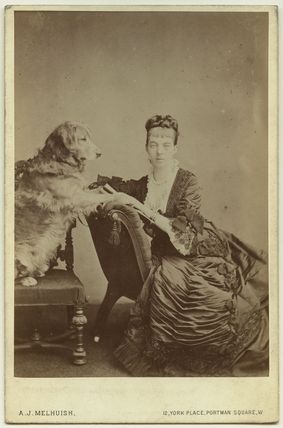
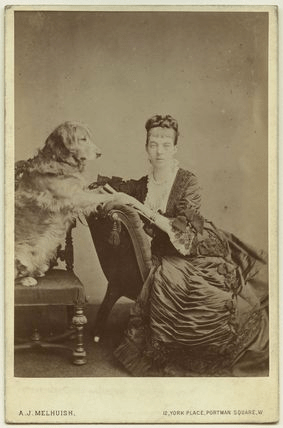
No known photograph of Cowslip exists, but her sister Crocus is shown here.
Whiskey (Wavy-coat, Farquharson’s Fag x Topsy)
Ch (UK) Black Drake (Flat-Coated Retriever)
Susannah (Wimpole Peter x Park Wood Duck)
Am. Dual CH. Stilrovin Rip’s Pride OS DDHF
Am. CH. Lorelei’s Golden Rip ** OS
Am. CH. Lorelei’s Marshgrass Rebel CD ** OS DDHF
Am. CH. Nerrissida’s Finderne Folly II OS SDHF
Am. CH. Finderne Gold Cloud Of Kent OS SDHF
Am CH Cragmount’s Peter OS SDHF
Am. CH. Sunset’s Happy Duke OS
Am./Can./Bda. CH. Cummings’ Gold-Rush Charlie OS, Am./Can. SDHF
BISS Am Can CH Gold-Rush’s Great Teddy Bear OS SDHF
Am./Can. CH. Kachina Twenty Karat OS SDHF
Am CH Birnam Wood’s Mountin’ Ash OS
BISS Am CH Asterling Go Getm Gangbuster OS SDHF
High Endeavor’s Archibold Whitey
Dixie Rose DeRosa (2021)
This 45-generation pedigree was painstakingly sourced using K9Data.com Dixie Rose is a direct descendent of Cowslip.
Read more about the history of the Golden Retriever breed.

All testing and Dixie Rose’s health clearances are complete and after extensive rounds of testing, she has met every standard and issued her CHIC number! We are so proud! There is no better way to celebrate than with about 1,000 rounds of fetch. (read more about CHIC below)
CHIC# 193071

A CHIC number is issued when test results are entered into the database satisfying each breed-specific requirement and when the dog’s owner has opted to release the results into the public domain.
Dixie Rose’s results are public record. While our record is positive, it’s important to note that had she failed her test, that would have been public record too. I strongly believe that ethical breeding includes transparency of information and that it demonstrates our integrity and commitment to ethical breeding practices.
Permanent Identification
Regardless of breed, each dog must be permanently identified in order to have test results included in CHIC. Permanent identification may be in the form of a microchip or tattoo.
The Canine Health Information Center, also known as CHIC, is a centralized canine health database jointly sponsored by the AKC Canine Health Foundation (CHF) and the Orthopedic Foundation for Animals (OFA). CHIC, working with participating parent clubs, provides a resource for breeders and owners of purebred dogs to research and maintain information on the health issues prevalent in specific breeds.
Browse by breed to see if your dog breed is currently enrolled in the CHIC program and what tests are required to obtain a CHIC number.
To find a dog already in the CHIC Database, search here.
For more information about CHIC eligibility, obtaining a CHIC number, fees, and how to enroll a breed in the CHIC program read the CHIC Frequently Asked Questions.
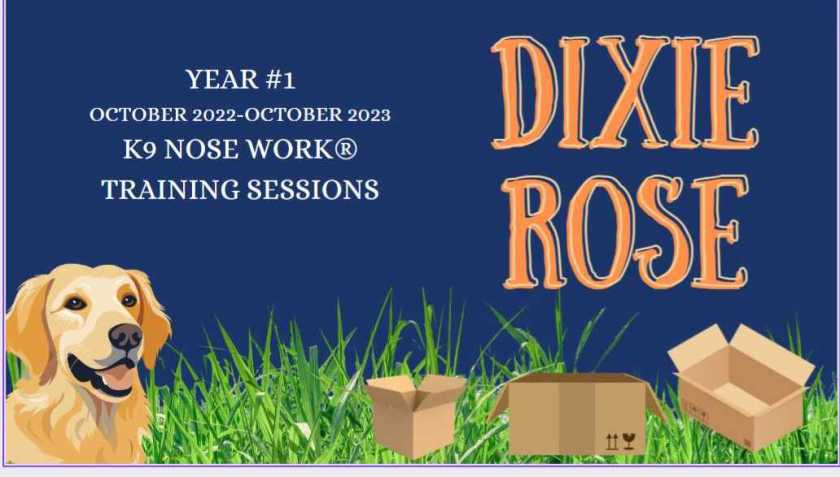
This marks our 1-year anniversary with Gaunt Nose Dog Training guru Julie Gaunt-Harris. This wonderful sport was founded by Julie’s father Ron Gaunt along with his colleagues Amy Herot and Jill Marie O’Brien. Julie is a professional handler and trainer of narcotics and explosive detection canine. K9 Nose Work® is a fun game for any dog and can become a field trial sport for dogs that pass their Odor Recognition Test (ORT).
My goal is for Dixie Rose to pass the ORT this year (2023) but as any proper trainer will tell you, the dogs already know what to do, it’s the handler that needs the training! And I am still solidly at level zero.
Intro to Nose Work
The foundations of K9 Nose Work®️. Dog search for a special treat or toy and self reward. This is also called “boxes” and we spent the better part of the year in boxes.
The dog is released into the search area full of boxes. One box (the hot box) contains the special treat/reward. When the dog finds the correct box, they self-reward by getting to eat the treat. The dog develops a lot of foundational skills in boxes, although it feels too easy when you watch. What dog doesn’t love finding treats? That’s the idea! The dog learning to associate a command (“find it” or “search”) with the game of searching through boxes and “finding” the reward. Dixie Rose’s special treat is salmon skin.
After several months, odor is introduced to the box. Now, when she finds her treat, she smells the odor. Dixie Rose can identify birch, anise, and cloves most of the time. The ORT (test) is challenging in that the odor is not paired with their treat, so it requires the handler to notice the dog’s behavior in a way that indicates finding an odor. (This is so much harder than it looks!) Identifying when my dog is “in odor” is why we are still at level zero. I’m working on it, and with some extra practice, we should be ready for her ORT in the coming months.
I hope you enjoy our year-in-a-video scrapbook of her learning this fun sport!
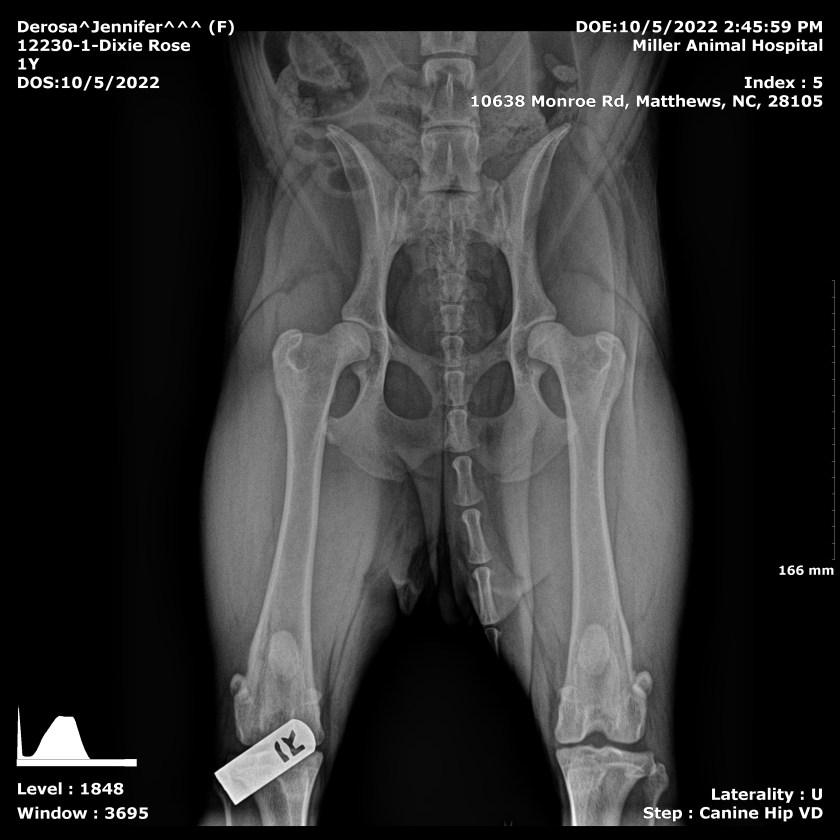
Dixie Rose DeRosa passed her OFA health screenings with flying colors. She’s sleepy from the anesthesia, but wow are we excited!
Orthopedic Foundation for Animals (OFA) health tests for hips, elbows, patella (knee), and cardiac.
What to expect: we arrived at our vet’s office this afternoon and she was weighted and briefly examined before being taken back for sedation. She had the following tests performed: hips, knees, shoulders, and elbows. She had a dental assessment as well. During her visit she was in heat, so she was in a diaper! But, that doesn’t interfere with the process at all.
After the procedure, our vet does an initial assessment and gave us a report. Everything looks wonderful, and now our paperwork is sent into the “official” OFA for assessment and recording of the results. Results are important, and they won’t perform the tests unless you consent to releasing ALL results – good or bad– so any dog that is tested will have a public record for anyone to obtain. Part of the record required us providing her AKC registration information as well as the AKC registration of both her parents. The science lover in me appreciates the contribution to the body of knowledge that this process makes. Her parents have a long AKC pedigree, but were not OFA tested, so it was really important to me that we stepped up.
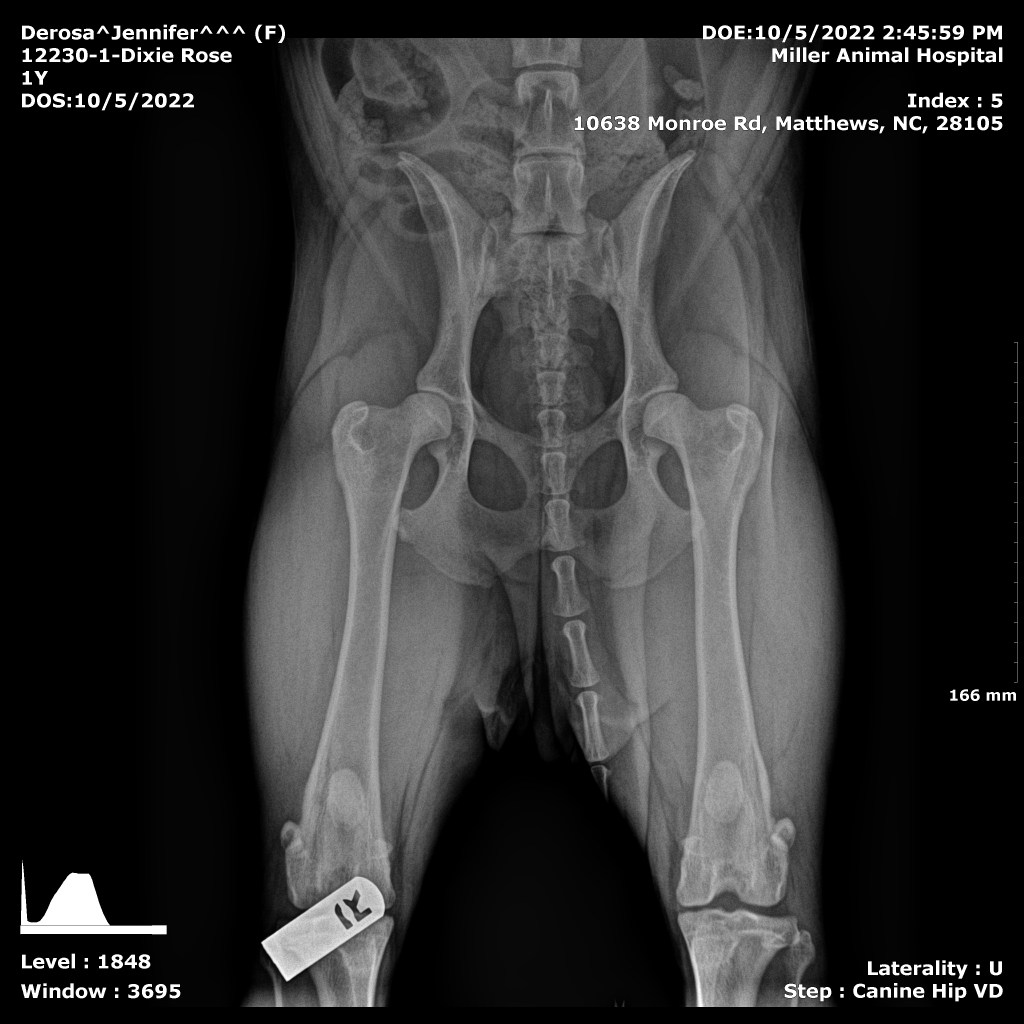

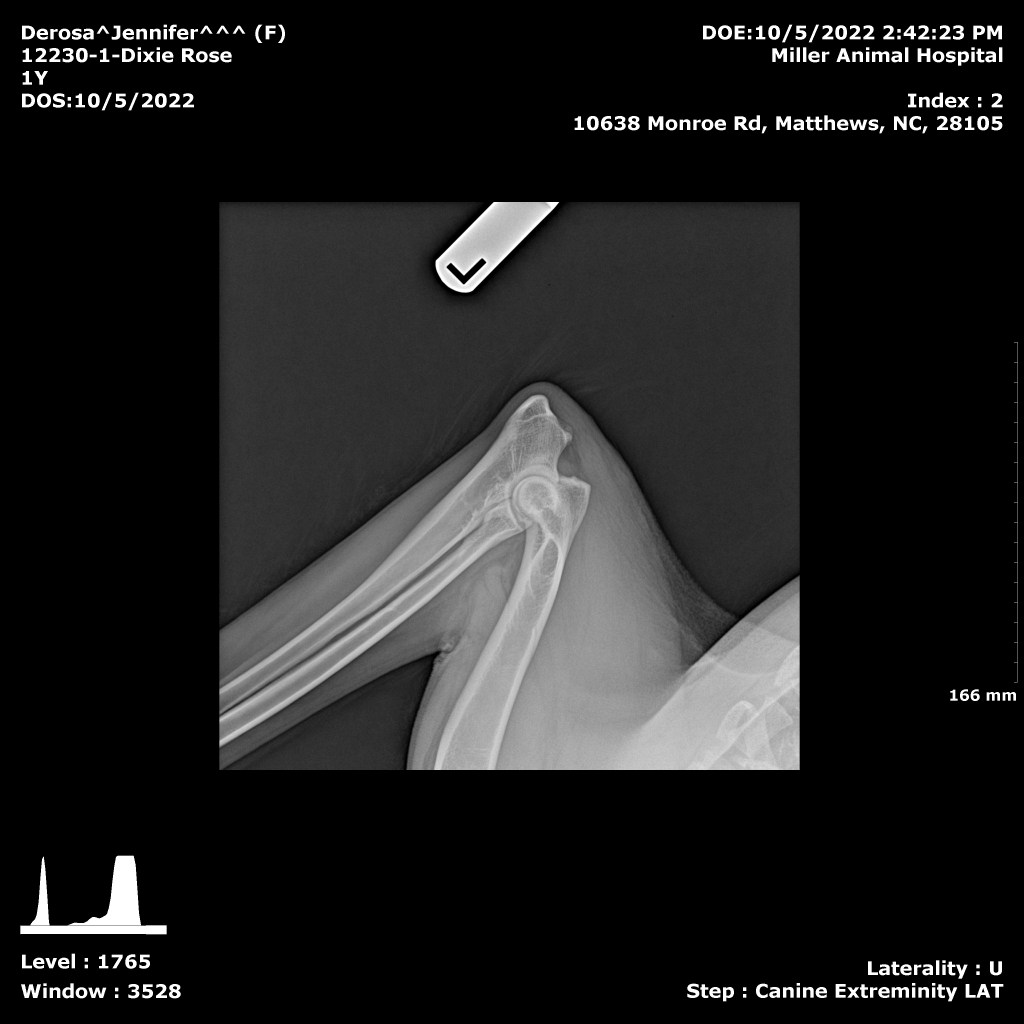
These results mean that in 1 year, she’ll be able to have her final hips and elbows exam. It will be a repeat of this one, and if she passes these exams again at the 2 year mark, it’s one more assurance that her health is excellent and fit for reproducation.
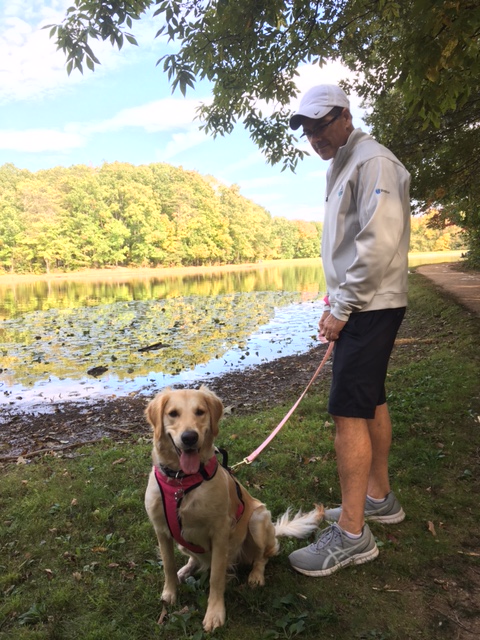
We just celebrated Dixie Rose’s 1 year birthday, and that means it’s time for her first full OFA Health Screening. Our veterinarian will administer her essential Orthopedic Foundation for Animals (OFA) health tests. While this is always important before breeding a dog, having this valuable information early in your dog’s life can give you information to help your dog live its best life because you have knowledge early on.
The Orthopedic Foundation for Animals is a nonprofit organization based in Columbia, Missouri, that aims to research and prevent orthopedic and hereditary diseases in companion animals.
OFA tests are voluntary, become public record, and quite expensive. When an owner has these tests done, it makes a statement about their commitment responsible dog ownership and quality of the breed. OFA testing has nothing to do with being a “show dog” but owners of registered dogs add their dogs to the OFA database for the good of the entire breed. It allows all of us to trace a dog’s health for many generations. It also allows the tracing of diseases.
After a dog has completed these tests, the results are recorded in a database that’s easily accessible to everyone. It’s important to remember that having the possibility of diseases like hip dysplasia or eye issues doesn’t diminish your pup’s lovability; it’s simply information that can help inform health management and breeding choices. Being a responsible dog owner means making sure we don’t breed dogs with health issues, and registering all dogs in the database is a positive step for the well-being of our dogs and the wider community.
 Golden Retriever Puppies